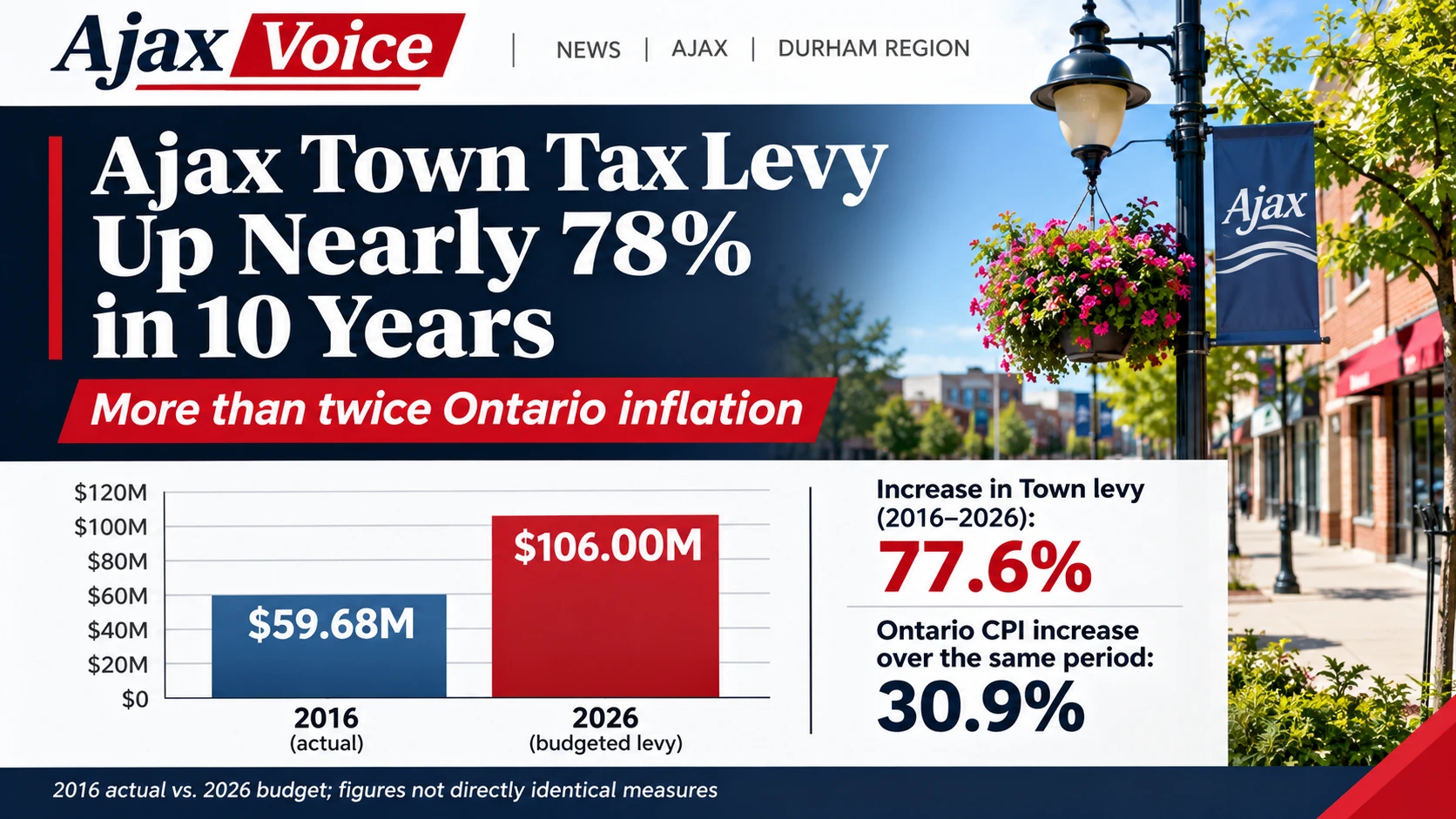
In 2016, the Town collected $59.7 million in property taxes for its own purposes, as reported in its Financial Information Return (FIR) filed with the Province. That is an increase of $46.3 million, or about 77.6 percent. Over the same 10 years, Ontario's consumer price index rose 30.9 percent.
Had the Town's 2016 property-tax revenue grown only with inflation, it would be about $78.1 million today. The 2026 levy is about $27.9 million higher than that.
The comparison mixes two measures: an audited 2016 actual and a 2026 budget. The Town's 2016 budget book was not available online or in web archives. Actual tax revenue usually comes in slightly above the budgeted levy because of supplementary taxes. In 2025, for example, FIR actual taxation was $101.9 million against a levy of $100.5 million. Because of that, the 78 percent figure is, if anything, a little low. Using FIR actuals for both ends, Town tax revenue rose 70.8 percent from 2016 to 2025, a span of nine years.
Growth explains part of the increase. Statistics Canada counted 119,677 people in Ajax in 2016 and 126,666 in 2021, an increase of 5.8 percent. New homes and businesses ("assessment growth") add to the levy each year without raising anyone's tax rate. The Town's annual "tax rate increase" measures the change for existing taxpayers. Those increases were modest early in the decade: 2.52 percent in 2016, 2.25 percent in 2017 and 2.75 percent in 2018. Since 2023, they have been much larger: 9.55, 7.59, 5.78 and 3.90 percent. Compounded, the four budgets from 2023 to 2026 add up to about 29.5 percent, nearly as much as inflation over the whole decade.
These figures cover only the Town's part of the tax bill. Ajax is a lower-tier municipality in the Region of Durham. The Region, not the Town, pays for policing (Durham Regional Police Service), public transit (Durham Region Transit), water and sewer, and garbage and green-bin collection. Those costs appear in the Region's budget, not the Town's. The Town's 2026 Operating Budget says the Town keeps 33 percent of a typical tax bill, the Region 56 percent and the school boards 11 percent. According to the 2026 Budget Snapshot, the Town's 3.90 percent increase adds 1.28 percent to the total bill, or $84.56 a year on a home assessed at $495,200.
A decade of Town budgets
How this review measured the budget. The main yardstick is the Town's general tax levy, the "amount to be raised from property taxation" set through each year's budget. The Town's 2026 Budget Snapshot calls it the "Tax Funded Operating Budget." It is the base from which the Town calculates the next year's percentage increase. For 2019, 2021 and 2023 to 2026, the figure appears directly in a budget book, staff report or committee minutes. For 2018, 2020 and 2022, this review calculated it from official tables, as explained in the notes. No 2016 or 2017 levy was found in official sources available online, so the FIR's audited "taxation – own purposes" is shown for every year as a consistent cross-check. Capital budgets swing widely with single projects. They show what Council authorized, not what was spent.
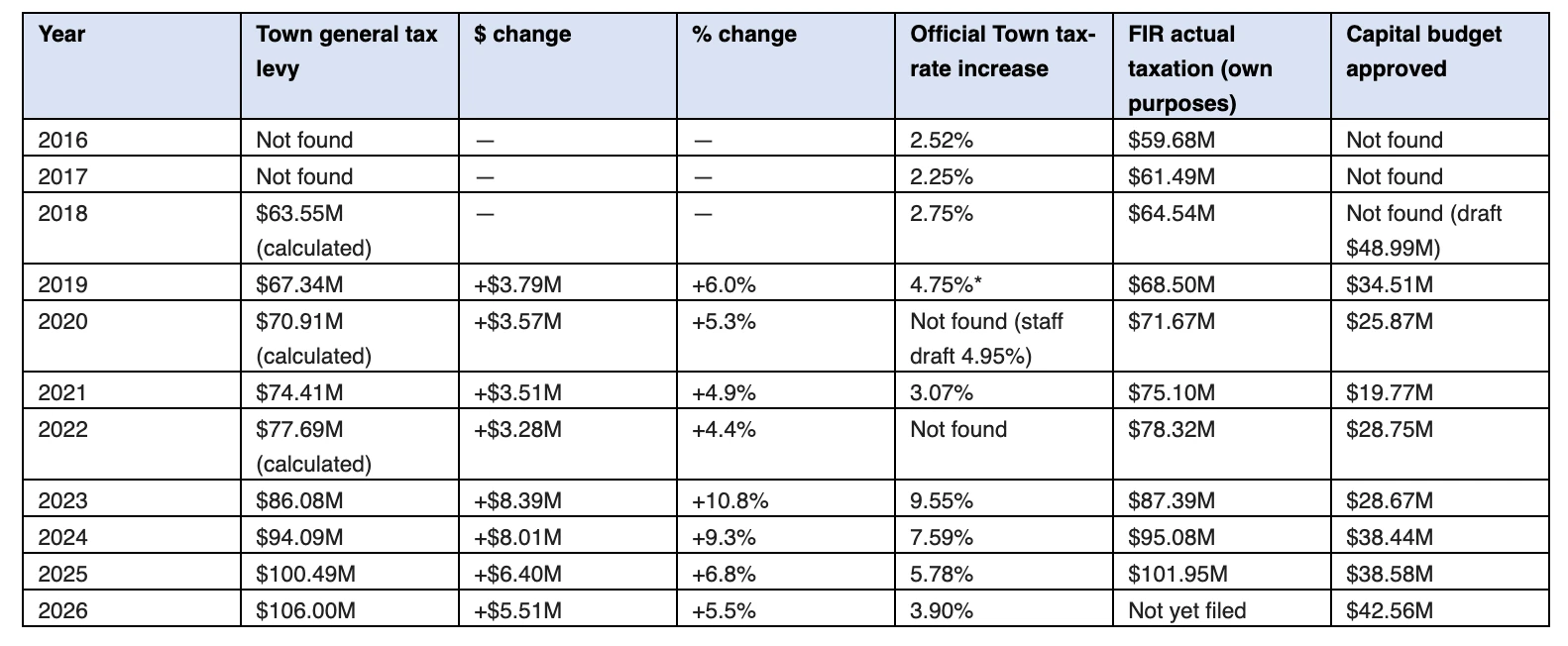
Sources: Town of Ajax operating and capital budget books, 2019–2026; the 2018 Operating Budget presentation (2016–2018 tax-rate increases); the Treasurer's 2019 Operating Budget report; minutes of the General Government Committee (GGC) budget meetings of Feb. 3, 2020, and Feb. 8, 2021; report FIN-2023-04; Ontario Financial Information Returns, Schedule 10, line 0299 (2016–2025). Dollar and percentage changes were calculated by this review. The 2018 levy is the 2018 net operating budget plus reserve allocations, as shown in the 2019 budget book. The 2020 and 2022 levies were calculated by subtracting assessment growth from the following year's published tax base; the Town's final 2020 and 2022 tax-rate increases were not found. *The 2019 rate is the one in the Treasurer's report; Council's March 25, 2019, amendments raised the levy slightly afterward. The 2018 capital figure is the staff draft; the approved amount was not found.
What drove the biggest jumps
2023 (9.55 per cent). This was the largest increase of the decade. Report FIN-2023-04 lists the drivers. Inflation added 3.87 points. New and other costs added 2.12 points, including $1.0 million to annualize 20 firefighters hired in 2022 and to promote four firefighters to captain. Reversing a one-time 2022 draw from the Stabilization Reserve, used to soften the cost of the new recruits, added 0.99 points ($778,000). New staff positions ("business cases") added $1.92 million, or 2.45 points. Council also approved a new 2 percent infrastructure levy of $1.57 million for asset replacement (report FIN-2023-02). Moving stormwater costs off the tax levy saved $654,700, and assessment growth offset 1.16 points.
2024 (7.59 per cent). This was the first budget under Ontario's "strong mayor" powers. The 2024 Operating Budget (Amended) shows inflation adding $3.11 million and "new and other impacts" $4.21 million. The latter included an additional $1.75 million of infrastructure levy for asset-management reserves. New positions and contracts added $1.07 million, including $209,000 for security contracts.
2025 (5.78 per cent). Nearly 2 points of the increase ($1.88 million) was the 2 percent capital infrastructure levy. Inflation added $3.99 million, or 4.20 points.
2026 (3.90 per cent). Inflation added $5.13 million, or 5.03 points. The 2026 book says Elexicon revenue was eliminated ($2.01 million) and Casino Ajax revenue fell by $1.25 million. The book shows those losses offset mainly by lower contributions to capital reserves and higher investment income. The infrastructure levy was set at 1 percent ($1.02 million), down from 2 percent in 2023 to 2025.
2019 (4.75 per cent). The Treasurer's report shows the Audley Recreation Centre Phase 2 adding $899,400 (Town and Library), new staff $448,100 and service improvements $644,800.
2018 (2.75 per cent). The 2018 Operating Budget presentation says Council approved a one-time 1.00 percent increase in November 2017 to pay for the province's Bill 148 minimum-wage changes, budgeted at $703,500. The base increase was 1.75 percent.
Staff proposals versus Council decisions
From 2016 to 2023, the Director of Finance/Treasurer presented a draft budget to the General Government Committee each year, and Council approved the final budget. Since 2024, the Mayor has proposed the budget under strong-mayor powers. Council may amend it, and the Mayor may veto amendments. Mayor Shaun Collier waived his veto each year in writing (Mayoral Decisions 1-2024, 3-2024 and 1-2025). Each budget was then deemed adopted.
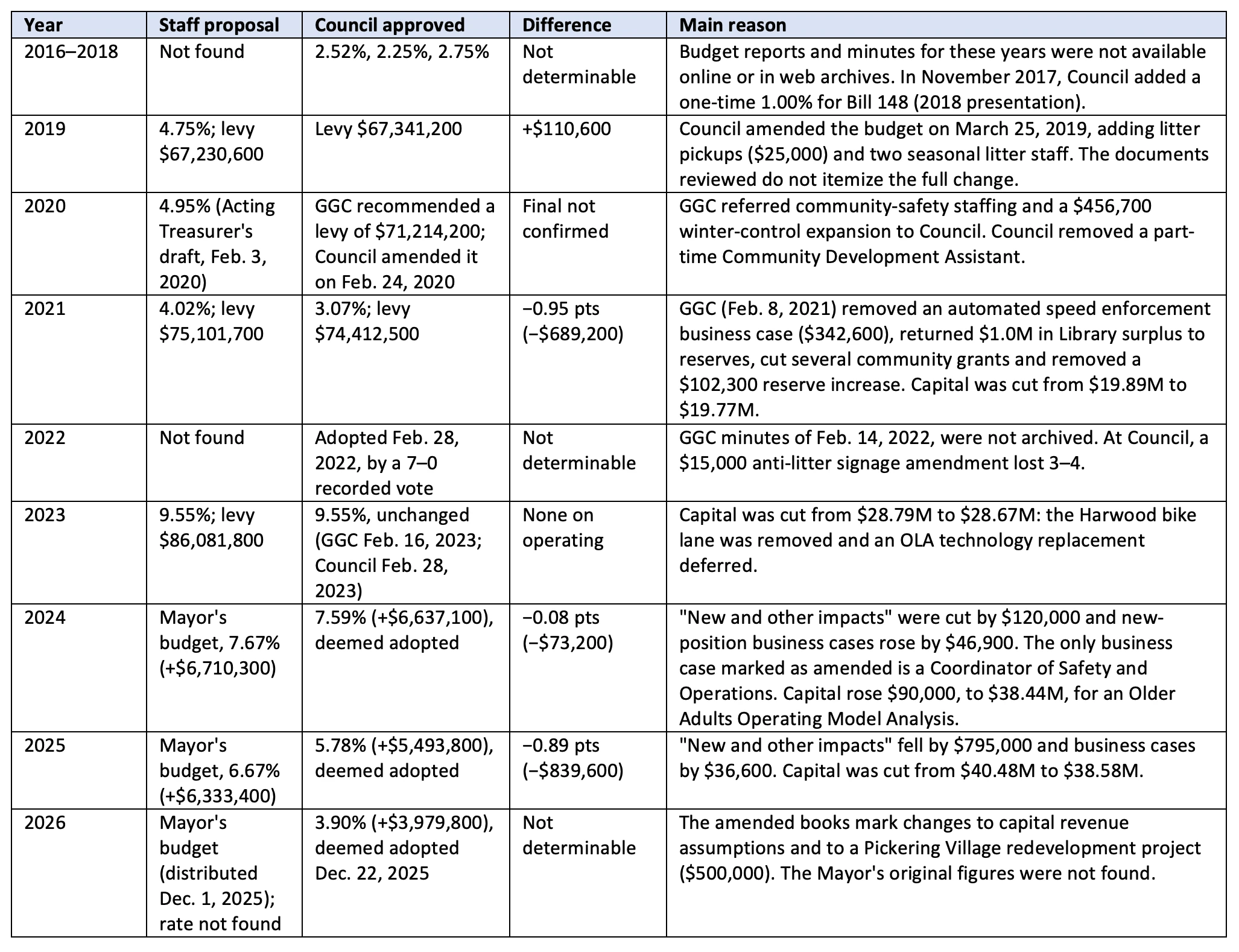
Sources: the Treasurer's 2019 Operating Budget report and 2019 Council-amended budget books; GGC minutes of Feb. 3, 2020 (in the March 9, 2020, GGC agenda); the Feb. 3, 2020, Operating Budget presentation; the Treasurer's 2021 budget report and GGC minutes of Feb. 8, 2021; Council minutes of Feb. 28, 2022 (in the March 28, 2022, Council agenda); report FIN-2023-04 and GGC minutes of Feb. 16, 2023; the 2024 Mayor's proposed and amended operating budgets; the 2024 and 2025 budget presentations and amended books; the 2026 amended books; Mayoral Decisions 1-2024, 3-2024 and 1-2025. Differences were calculated by this review.
The largest change Council made came in 2021. Treasurer Dianne Valentim recommended a 4.02 percent increase. At the Feb. 8, 2021, General Government Committee meeting, chaired by Councillor Ashmeed Khan, members trimmed it to 3.07 percent. Councillor Marilyn Crawford moved to remove the automated speed enforcement business case. Regional Councillor Shaun Collier moved to return $1.0 million in Library surplus to reserves ($700,000 to the Stabilization Reserve and $300,000 to stormwater), to remove a $102,300 reserve increase and the IMPACT Ajax grant ($106,600), and to cover a $239,300 drop in recreation revenue from COVID-19 funding. Councillor Lisa Bower amended a grants motion to cut the hospital grant to $25,000 and remove the Durham Community Foundation grant. A motion to cut the Library's increase from $189,000 to $139,000 failed. Councillor S. Lee moved the final budget motion.
In 2023, the 9.55 percent budget passed unchanged. The General Government Committee approved staff's operating budget on Feb. 16, 2023, on a unanimous recorded vote, with Mayor Collier as chair. Councillor Bower moved the new 2 percent infrastructure levy. Council's only changes were to capital.
Under strong-mayor powers, Council amendments have lowered the Mayor's proposals. The reductions were small in 2024 ($73,200) and larger in 2025 ($839,600, close to 0.9 points). In both years, most of the change came from the "new and other impacts" line in the amended books. The amended books do not give a line-by-line list of Council's motions, and the meeting minutes for the amendment periods (January 2024, December 2024 and December 2025) were not available to this review.
Recorded votes. The 2022 budget passed 7–0. On the defeated $15,000 litter-signage amendment, Councillors Crawford, Lee and Rob Tyler Morin voted in favour. Councillors Joanne Dies, Khan, Bower and Collier voted against. The 2023 budget passed unanimously at committee.
Who was responsible
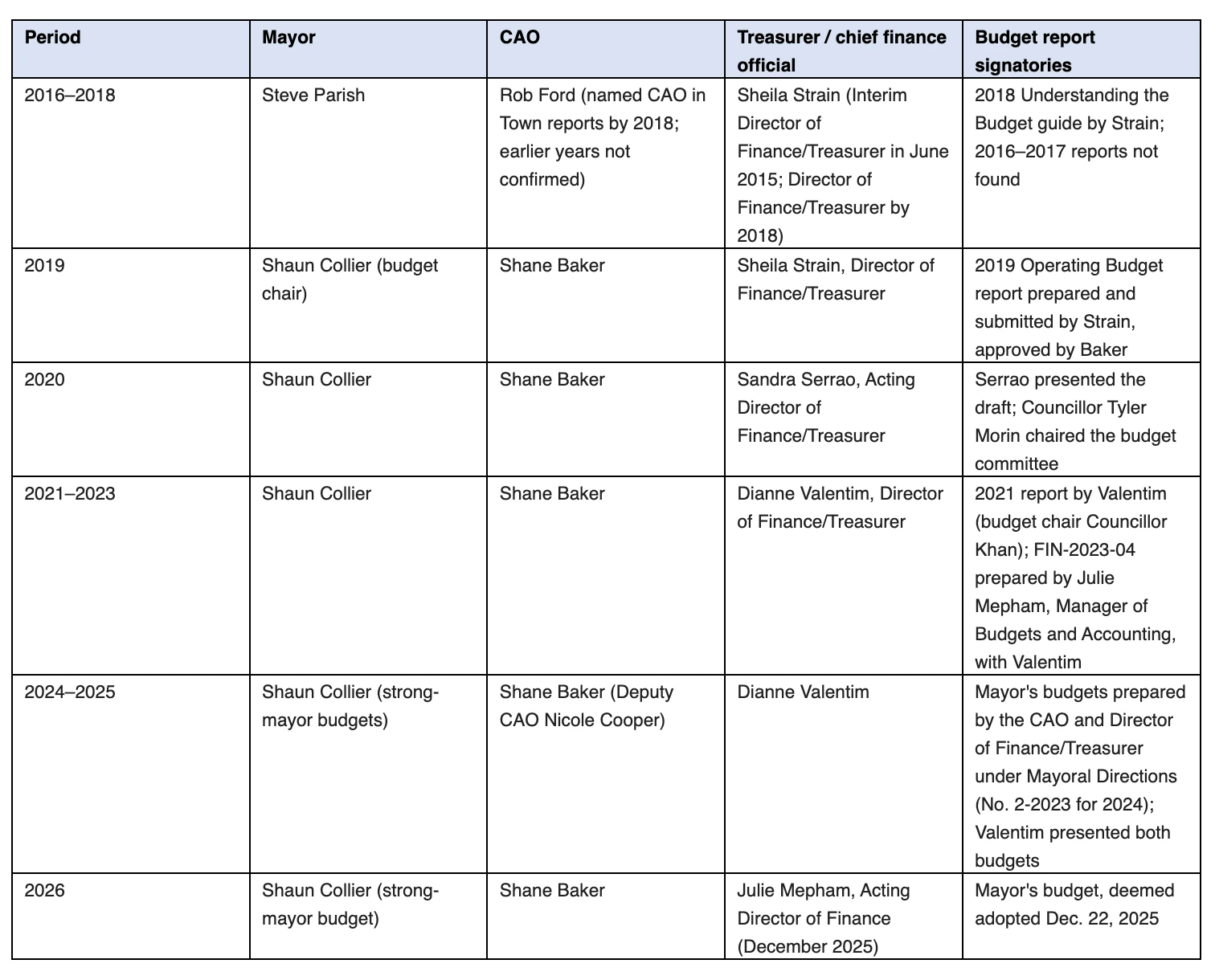
Councillors who moved the main budget motions or amendments included Shaun Collier (as Regional Councillor in 2020 and 2021, then as Mayor in 2023), Marilyn Crawford (2020 and 2021), S. Lee (2021 and 2022) and Lisa Bower (2021 and 2023). Mayor Marilyn Crawford took office in November 2026. She was a member of Council for every budget in this review, but the 2027 budget would be the first prepared under her strong-mayor authority.
Unspent money and delayed projects
Unfinished capital work stood at $14.7 million at the end of 2025. The Town's audited statements report "construction in progress" of $13.97 million at the end of 2017 and $33.89 million at the end of 2018. The balance fell to $3.77 million in 2021 and has been between $12.7 million and $14.9 million since 2022 ($14.66 million at the end of 2025). The statements also show an "internal capital fund" of $10.18 million at the end of 2025, down from $15.26 million in 2024. They do not say how much of these balances is tied to approved projects that have not started.
Money returned from closed projects. The Town reports capital closings to Council under its Financial Sustainability Plan. The one report found from this period, to the General Government Committee on Nov. 9, 2020, closed 29 projects and returned or uncommitted $4.01 million. Most of it ($3.16 million in federal gas tax funding) came from cancelling the Admiral Road construction project after bids came in over budget. The report said the project would be "re-budgeted in 2021." Later closing reports were not found.
Deferrals during budget debates. In 2021, the General Government Committee moved a customer service strategy project to 2022, removed a project for signage on municipal property and dropped a Paradise Park volleyball and playground project from the forecast. In 2023, it deferred an OLA technology replacement to 2024 ($75,000) and removed the Harwood bike lane (Falby to Westney).
Large projects ahead. The 2025 capital forecast shows a $40.1 million renovation of the Ajax Community Centre (ACC) over 2025–2027, with design work listed in the 2026 Budget Snapshot. The 2026 capital budget of $42.56 million continues the Rossland Road expansion and Harwood Avenue widening. The 10-year capital forecast in the 2026 book totals $603.0 million.
Questions staff should be able to answer
1. The Town has raised its tax rate by a compounded 29.5 percent from 2023 to 2026. How much of that went to the infrastructure levy, and what has the levy paid for so far?
2. Elexicon revenue was eliminated and Casino Ajax revenue fell in 2026, and the 2026 book shows lower contributions to capital reserves as a result. What would the 2027 tax increase need to be to restore those contributions?
3. How much of the $14.7 million in construction in progress and the $10.2 million internal capital fund at the end of 2025 is tied to projects approved more than two years ago?
4. Can the Town publish a list of each Council amendment to the Mayor's 2024, 2025 and 2026 budgets, with its dollar value?
Data gaps and notes
This review used only Town of Ajax budget books, staff reports, agendas, minutes, audited financial statements and Financial Information Returns, plus Statistics Canada data. The Town's 2016, 2017 and 2018 budget books and the related committee reports were not available on the Town's website or in web archives. For those years, the article relies on the FIR, the 2017 and 2018 audited statements and the 2018 budget presentation. The final tax-rate increases for 2020 and 2022, the staff proposal for 2022 and the Mayor's original 2026 proposal were not found. The 2018, 2020 and 2022 levy amounts were calculated by this review from official tables and are flagged above. The Town's meeting portal could not be reached directly, so minutes come from archived copies. Some minutes, including GGC Feb. 14, 2022, and the 2024–2026 amendment meetings, were not available.
The latest documents used are the Town's 2025 Financial Information Return (last updated July 29, 2026) and its 2025 audited consolidated financial statements (dated June 16, 2026). Inflation figures are from Statistics Canada Table 18-10-0004-01 (Ontario all-items CPI, September 2016 and September 2026).